Real-time audio and video communications have evolved from a niche capability into a core requirement for modern applications—from telehealth and remote education to live streaming and collaborative workspaces.
When engineering real-time features, developers face a crucial architectural decision: Should you build directly on WebRTC mesh, leverage third-party PaaS like Agora or ZEGOCLOUD, or operate a self-hosted Selective Forwarding Unit (SFU) such as Mediasoup?
1. Peer-to-Peer WebRTC: The Foundation
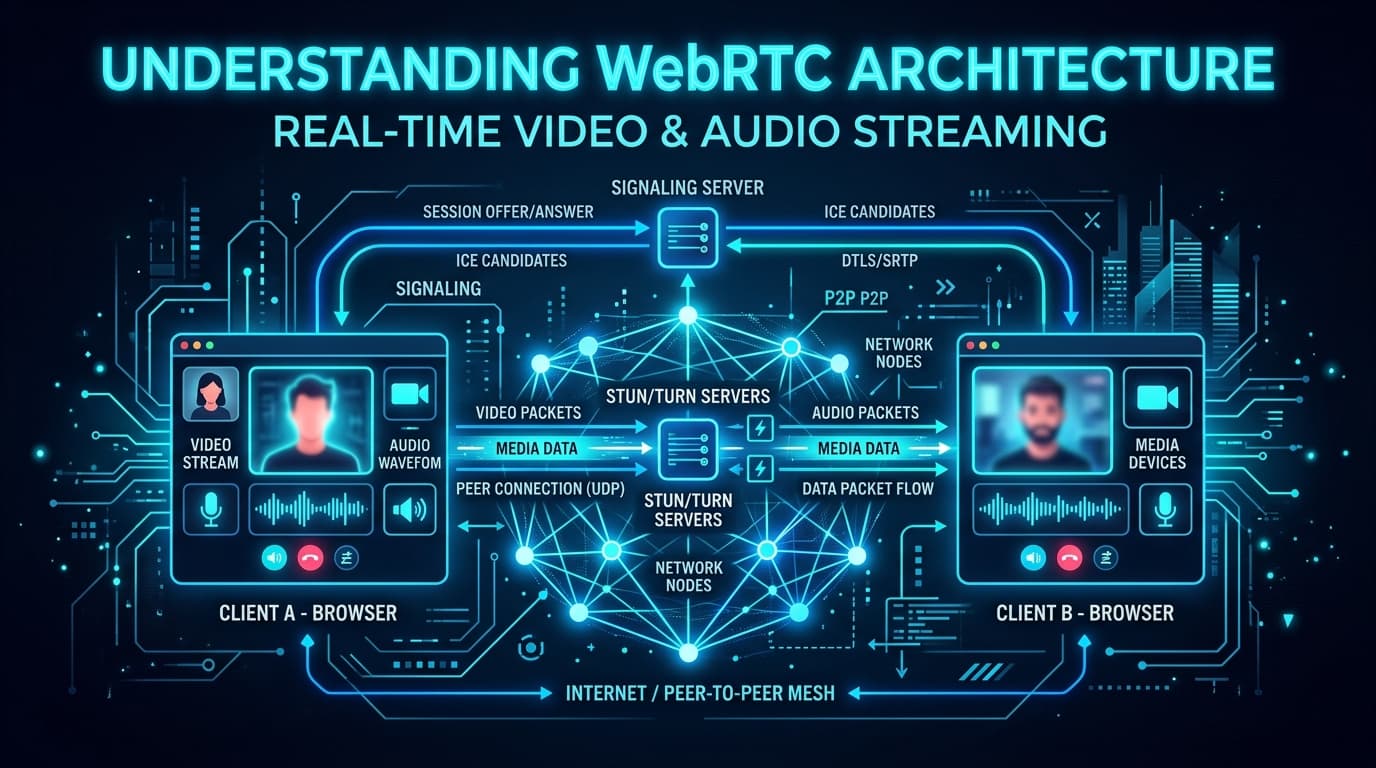
WebRTC enables direct browser-to-browser media streaming via RTP/RTCP after exchanging SDP (Session Description Protocol) offer/answers through a signaling server (typically powered by WebSockets).
// Initializing a standard RTCPeerConnection
const peerConnection = new RTCPeerConnection({
  iceServers: [
    { urls: 'stun:stun.l.google.com:19302' },
    {
      urls: 'turn:turn.yourdomain.com:3478',
      username: 'user',
      credential: 'password'
    }
  ]
});

// Adding local media tracks to peer connection
localStream.getTracks().forEach((track) => {
  peerConnection.addTrack(track, localStream);
});
When to use P2P:
- 1-on-1 audio/video calls.
- Low-budget projects where server media relay bandwidth costs must be minimal.
- Absolute end-to-end privacy requirements without intermediary servers.
2. Agora & ZEGOCLOUD: Enterprise Cloud PaaS
For multi-party video conferencing, global latency optimization, and rapid production time-to-market, platforms like Agora and ZEGOCLOUD provide dedicated Software-Defined Real-Time Networks (SD-RTN).
- Global Edge Acceleration: Traffic automatically routes through optimal edge nodes worldwide.
- Adaptive Bitrate & Packet Loss Resilience: Capable of handling up to 70-80% packet loss without dropping calls.
- Rich Client SDKs: Ready-made SDKs for React, Next.js, Flutter, Android, and iOS with active speaker detection, virtual backgrounds, and screen sharing.
import AgoraRTC from "agora-rtc-sdk-ng";

const client = AgoraRTC.createClient({ mode: "rtc", codec: "vp8" });
await client.join(APP_ID, CHANNEL_NAME, TOKEN, UID);

const [localAudioTrack, localVideoTrack] = await AgoraRTC.createMicrophoneAndCameraTracks();
await client.publish([localAudioTrack, localVideoTrack]);
3. Mediasoup: The Power of a Custom SFU
When you need full control over media pipelines, custom recording, ML computer vision processing, or want to avoid per-minute PaaS costs at large scale, Mediasoup is an unmatched choice. Written in C++ as a Node.js native addon, it acts as a high-performance Selective Forwarding Unit (SFU).
Unlike an MCU (Multipoint Control Unit) that decodes, mixes, and re-encodes video streams (which demands heavy CPU usage), an SFU acts as an intelligent router—receiving streams once and selectively forwarding them to peers based on available bandwidth (simulcast / SVC).
| Metric / Feature | Native WebRTC (Mesh) | Agora / ZEGOCLOUD | Mediasoup SFU |
|---|---|---|---|
| Max Participants | 3 - 5 users | 1,000+ users | 100+ per room |
| Bandwidth (Client) | Scales exponentially (N-1) | Low (Client sends 1 stream) | Low (Client sends 1 stream) |
| Server Overhead | Only Signaling server | None (Managed Cloud) | High (VPS / Dedicated Server) |
| Cost Model | Free / STUN-TURN servers | Per-minute usage | Fixed server infrastructure |
| Custom Control | High | Low - Moderate | Maximum |
Key Takeaways & Recommendations
- For 1-to-1 video chats, standard WebRTC with a lightweight Node.js/Socket.io signaling server is straightforward and economical.
- For fast MVP launches or mission-critical global webinars, integrate Agora or ZEGOCLOUD to offload infrastructure burdens.
- For privacy-first enterprise platforms or proprietary AI video processing, host a Mediasoup SFU on a high-bandwidth Linux VPS with Docker.