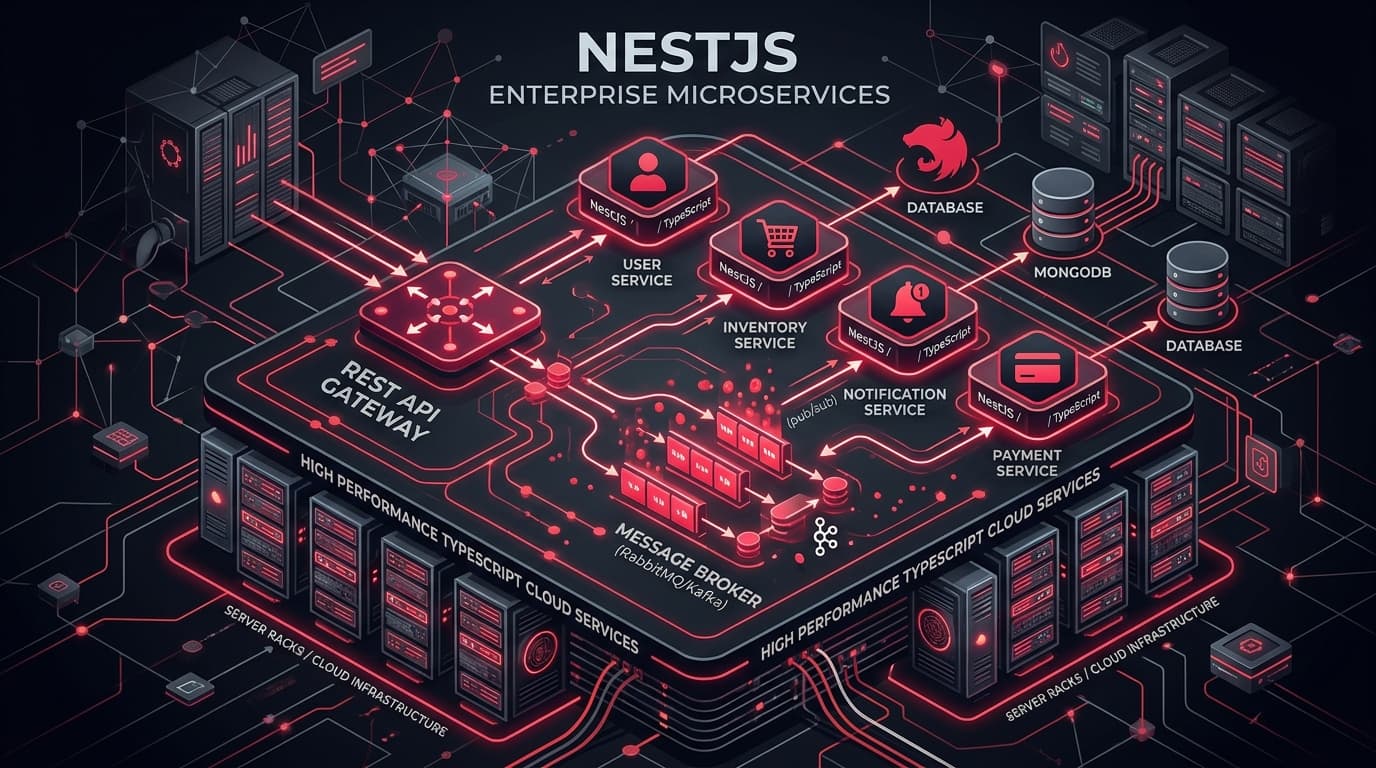
Building backend services with Node.js and Express often starts quickly, but as codebases grow, they can easily turn into messy, untyped architectures with inconsistent patterns.
Enter Nest.js—a progressive Node.js framework built with TypeScript that brings architectural discipline inspired by Angular, while preserving complete flexibility with underlying engines like Express or Fastify.
Why Nest.js Stands Out
- First-Class TypeScript Support: Strong typing ensures compile-time safety and prevents runtime bugs.
- Dependency Injection (IoC Container): Inversion of control allows clean decoupling of controllers, services, and repositories.
- Modular Architecture: Organize complex applications into self-contained domain modules (
AuthModule,UsersModule,PaymentModule). - Declarative Decorators: Streamlined handling of HTTP routes, parameters, validation, and serialization.
Constructing a Production Service with Validation & Prisma
Below is a typical pattern combining Nest.js Controller, Service, and Class-Validator DTOs:
typescript
// create-user.dto.ts
import { IsEmail, IsNotEmpty, MinLength } from 'class-validator';

export class CreateUserDto {
  @IsEmail()
  email: string;

  @IsNotEmpty()
  @MinLength(6)
  password: string;

  @IsNotEmpty()
  fullName: string;
}

// users.controller.ts
import { Controller, Post, Body, UseGuards } from '@nestjs/common';
import { UsersService } from './users.service';
import { CreateUserDto } from './dto/create-user.dto';
import { JwtAuthGuard } from '../auth/guards/jwt-auth.guard';

@Controller('users')
export class UsersController {
  constructor(private readonly usersService: UsersService) {}

  @Post('register')
  async register(@Body() createUserDto: CreateUserDto) {
    return this.usersService.createUser(createUserDto);
  }
}
Microservices with Redis & RabbitMQ
One of Nest.js's biggest strengths is its abstraction layer for microservices. Moving from an HTTP monolith to a message-driven distributed architecture requires minimal code rewrites:
typescript
// main.ts (Microservice Listener)
import { NestFactory } from '@nestjs/core';
import { Transport, MicroserviceOptions } from '@nestjs/microservices';
import { AppModule } from './app.module';

async function bootstrap() {
  const app = await NestFactory.createMicroservice<MicroserviceOptions>(AppModule, {
    transport: Transport.REDIS,
    options: {
      host: 'localhost',
      port: 6379,
    },
  });
  await app.listen();
}
bootstrap();
Best Practices for Nest.js in Production
- Use Global Exception Filters: Ensure unified JSON error responses across your entire API.
- Implement Custom Guards: Protect routes based on JWT signatures, RBAC (Role-Based Access Control), or API keys.
- Leverage Swagger / OpenAPI Auto-generation: Use
@nestjs/swaggerdecorators to keep live interactive API documentation in sync with your DTOs.